
Short answer: Lifting straps are straps that wrap around the wrist and around the bar, so your grip doesn't give out before the muscles you're training. They make the most sense for heavy pulling exercises like deadlifts, rows, and pulldowns – and the least sense for exercises where grip is the goal itself.
In this guide, you'll find answers to when you should use lifting straps, what types exist, how to put them on correctly, and what to look for when choosing.
StrapIt lifting straps – made in Denmark
Over 50,000 pairs sold. OEKO-TEX®-certified materials and supplier to PureGym and SATS.
See all lifting straps →What are lifting straps?
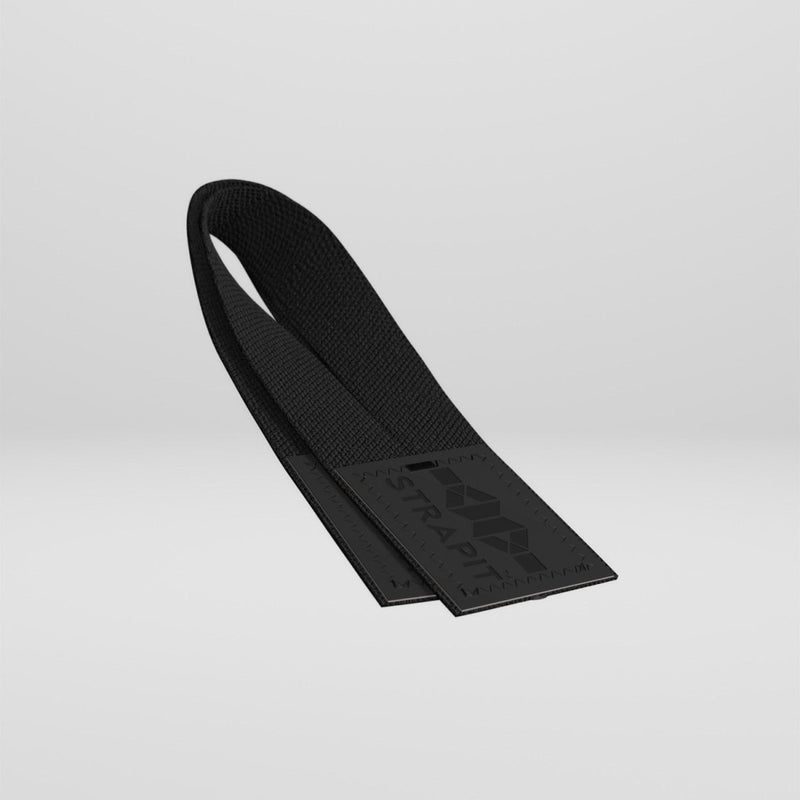
Lifting straps (in English lifting straps) are straps made of fabric or leather that connect your hands to the bar, handle, or cable. The strap sits around the wrist, and the free end is wrapped around the bar, so part of the load goes through the strap instead of through the fingers.
The purpose is simple: to remove grip as the limiting factor, so the back, hamstrings, and lats can work harder and longer.
Why does grip give out before the muscles?
In heavy pulling exercises, some of the body's largest muscles work – the back, glutes, and hamstrings. Grip, on the other hand, is controlled by the much smaller muscles in the forearm, and they get tired much faster.
Most people know the result: The bar begins to slip out of the hands long before the back is finished. The set ends, not because the muscles have had enough, but because the fingers cannot hold. Lifting straps move part of the load from the fingers to the wrist, so you can maintain form throughout the entire set. If you especially struggle with grip in deadlifts, also read lose your grip during deadlifts? 5 solutions that work.
When should you use lifting straps?

Heavy pulls – deadlifts, Romanian deadlifts, barbell rows, and rack pulls, where grip typically gives out before the back muscles.
Back exercises with a focus on muscle connection – lat pulldowns, seated rows, and T-bar rows, where you want to feel the back working instead of the forearms.
High volume – days with many sets and repetitions, where the hands become exhausted long before the muscles.
See more examples in 10 exercises with lifting straps.
When should you NOT use lifting straps?
When grip is the goal. In farmer's walks, dead hangs, and other grip exercises, it is precisely the forearms you are training.
During the warm-up. Let the hands work freely in the light sets, and only put on the straps when the weight becomes so heavy that grip compromises technique.
In powerlifting competitions. Lifting straps are not allowed in classic powerlifting, so if you compete, your own grip must be able to handle your heaviest lifts.
If you use straps for the heavy working sets and train grip separately, you get the best of both worlds. Read more in are straps bad for grip strength?
What types of lifting straps exist?
| Type | How it works | Best for |
|---|---|---|
| Lasso straps | The end is fed through a loop, the ring sits around the wrist, and the free end is wrapped around the bar | Most pulling exercises. Can be released quickly |
| Figure 8 | A figure eight, where the bar rests in the cross between two loops | Very heavy lifts, e.g., strongman. Cannot be released quickly |
| Closed straps | A single loop around the bar | Fast changes and Olympic lifts |
Lasso straps are the classic and most versatile choice. You can read more about the pros and cons in types of lifting straps – lasso, Figure 8, and fast straps.
Materials: cotton, nylon, or leather?
Cotton provides good friction against the bar and is comfortable against the skin, but can stretch a bit over time.
Nylon is strong and does not stretch, but can feel slippery against a bar with slight ridges.
Leather and bio-leather mold to the hand and bar, provide a firm grip, and are comfortable. Our StrapIt Premium is made of bio-leather and double cotton webbing.
Short, long, or premium?
| Model | Suitable for you who … | Price |
|---|---|---|
| StrapIt | want one strap for most of your training | from 249 kr. |
| StrapIt Premium | lift heavy and want extra comfort | 349 kr. |
| Long straps | want to be able to wrap multiple times around the bar | 249 kr. |
| StrapIt Personal Edition | want your own name or your own text on it | 400 kr. |
Short straps are quick to put on and take off and work well in machines and cables. Long straps provide more material to wrap with, which many prefer for heavy lifts with a bar. See the full comparison in short vs. long lifting straps and Standard vs. Premium vs. Short.
How to use lifting straps

It takes a couple of workouts to get used to, but then it quickly becomes second nature. Unsure about the size? Use the StrapIt size guide or read what size lifting straps should I choose?
Are lifting straps cheating?
No. Lifting straps are a tool on par with a belt, knee wraps, and wrist wraps. They remove grip as a limitation, so you can train the muscles you actually want to target. Most experienced lifters use them for selected exercises and train grip separately. Read the full explanation in are lifting straps cheating?
Washing and maintenance
Lifting straps last for several years if you take care of them. Let them dry completely after training before putting them back in the bag, and avoid the dryer. See how to wash them in how do you wash lifting straps? and how long they last in how long do lifting straps last?
Lifting straps from MakeIt – made in Denmark
At MakeIt, we have been making training equipment since 2014, and our StrapIt is made in Denmark. Over 50,000 pairs have been sold, the materials are OEKO-TEX®-certified, and we are a supplier to PureGym and SATS. StrapIt is also used by athletes such as Daniel Risgaard and Regin Stergakis.
Free shipping over 499 kr. Delivery in 2–4 business days. 100-day return policy.
Frequently asked questions about lifting straps
Are lifting straps good for beginners?
Yes, but use them thoughtfully. Build a solid basic grip first, and use straps for the heavy sets when grip begins to limit you. Read more in lifting straps for beginners.
What is the difference between lifting straps and wrist wraps?
Lifting straps help grip during pulling exercises. Wrist wraps support the wrist during pressing exercises like bench press and shoulder press. They solve two different problems, and many use both.
How much more can you lift with lifting straps?
It depends on how much grip limits you today. If you have a strong grip, the difference is small. If grip is your weak link, it can be large. See examples in how much more can you lift with straps?
Can you use lifting straps in powerlifting?
Not in classic powerlifting competition. In training, they can certainly be used for the heavy working sets.
How long do lifting straps last?
With normal use and care, a pair of lifting straps lasts for several years.
Find the right lifting straps
If you train back and heavy pulling, and grip gives out before the muscles, lifting straps are one of the most effective investments you can make in your training. Start with a pair of StrapIt, and use them on your heaviest working sets.